There is a question that every physician eventually confronts, and that medicine has never been able to fully answer: why do some people recover against all odds — while others with the exact same diagnosis do not?
The medical literature is full of what researchers carefully call "spontaneous remission" — cancer that disappears, paralysis that reverses, blindness that lifts, conditions deemed permanent that are simply gone. No one knows why. The honest answer is: something happened that our instruments cannot explain.
This article explores a possibility that the historical and clinical evidence strongly supports: that there is a Power capable of healing the human body that operates beyond the physical, biological plane — and that this Power has been accessed, documented, and witnessed consistently across cultures and centuries.
Before the Record: Maimonides and the Medical Tradition That Knew
The connection between spiritual alignment and physical health is not a modern discovery, nor is it unique to any single tradition. In the twelfth century, Maimonides — rabbi, philosopher, and one of the most respected physicians of his age — stated it as a medical and theological fact: a person who is disconnected from God cannot truly be well. The body is the vessel through which the spirit acts in the world. To care for it was a sacred duty. To neglect the spiritual dimension of a patient was not merely an oversight, it was an incomplete diagnosis.
"Since maintaining a healthy and sound body is among the ways of God — for one cannot understand or have any knowledge of the Creator if he is ill — therefore he must avoid that which harms the body." — Maimonides
The healers whose accounts follow were working from the same understanding, each in their own language, each from their own century. What they demonstrated was not new. It was a truth that serious medicine had always carried and that the modern world had largely set aside.
The First Documented Record: Jesus of Nazareth
Whatever your beliefs, secular historians — including skeptical ones — have reached a remarkable consensus: Jesus was understood by his contemporaries as someone through whom extraordinary healings occurred. The debate is not whether these events happened — even Jewish and Roman sources referenced the healings as true happenings — but how to interpret them.
The most striking pattern: Jesus located the key to healing not in himself, but in the person seeking it. "Your faith has made you well," he said repeatedly. He consistently refused to take credit, pointing always to God as the source. Where he encountered genuine surrender and openness, extraordinary things happened. Where he encountered hardness and resistance, he said he could do little.
"Your faith has made you well." — Jesus of Nazareth
165 Years of Medical Scrutiny: Lourdes, France
In 1858, in the small French town of Lourdes, a fourteen-year-old peasant girl named Bernadette Soubirous reported eighteen apparitions of a luminous woman near a rocky grotto by the river. The woman identified herself as "the Immaculate Conception" and directed Bernadette to uncover a hidden spring. Bernadette was ridiculed, investigated by civil and church authorities, and repeatedly pressured to retract her account. She never did. The spring she uncovered still flows today — and what has surrounded it for over 165 years is one of the most extensively documented records of unexplained healing in human history.
Thousands of healing cases have been examined at Lourdes by panels of physicians of any faith or none. A significant number have been formally declared to have no medical explanation in the current state of human knowledge. But what the investigators noticed — and what the published research on Lourdes consistently confirms — is that the healing is inseparable from the inner state of the person. Medical scholars studying Lourdes have noted that the decisive factors present in those who were healed include depth of prayer, genuine faith, and what one study described as fervor, surrender, and "a sensitivity to the spiritual atmosphere" that compounded the inner conditions, specifically, the inner reaching toward God for healing.
Perhaps the most compelling external witness was Dr. Alexis Carrel — a Nobel Prize-winning surgeon and one of the intellectual forerunners of what would become functional and integrative medicine. Carrel already understood, decades before it became mainstream, that health operates at the level of the whole person — the internal environment, adaptive capacity, the relationship between body and soul. He was not a naive witness. And yet in 1902, he travelled to Lourdes specifically to debunk the healing claims, encountered a woman in the terminal stages of peritoneal tuberculosis, documented her condition in his medical notes, and watched her recover — rapidly, completely, and by no mechanism his science could identify. He returned to Lourdes a second time and witnessed the restoration of sight to a blind child. Scholars who have traced his life describe the Lourdes encounter as "the shock" that set him on a thirty-year intellectual journey — one that culminated in his landmark book Man the Unknown (1935), in which he argued that humanity's attention must turn away from the material world and back toward "the body and the soul of man." The man who went to Lourdes to disprove miracles left as someone who spent the rest of his life trying to build a framework large enough to contain what he had seen.
Post-War Germany: Bruno Gröning and the Healing Stream
In 1949, in a Germany still shattered by war, a carpenter named Bruno Gröning began drawing tens of thousands of desperate people — arriving on stretchers and in wheelchairs — to a farmhouse in Bavaria. Among the documented recoveries: paralysis, blindness, multiple sclerosis, and severe war injuries that conventional medicine had declared permanent.
Gröning refused credit with unusual insistence. When asked what he was doing and what his power was, he answered:
"I must say, as I have said many times: I do nothing. I am merely someone who points the way. The healing does not come from me. It comes from the great, divine source. From God. I am only a mediator, a bridge for those who have forgotten how to receive… Do not thank me. Thank God. I am only a channel."
He described what he offered not as a miracle but as the restoration of something natural — a "healing stream" (Heilstrom) that flows through those who are in harmony with God and is blocked in those who are not. The Medical Scientific Group, founded in 1992 to investigate cases associated with Gröning's method, has documented thousands of healings with before-and-after medical records — conditions including cancer, chronic pain, and paralytic disorders.
"I am only a mediator — a bridge for those who have forgotten how to receive." — Bruno Gröning
The American Record: Kathryn Kuhlman
Kathryn Kuhlman (1907–1976) became one of the most documented healing ministers in American history — not because of the drama of her services, but because she actively invited medical scrutiny. Time Magazine in 1970 called her "a veritable one-woman shrine of Lourdes."
Dr. H. Richard Casdorph, a physician with over eighty published research papers, independently investigated ten cases from Kuhlman's ministry with complete medical documentation. His conclusion: natural recovery was not a plausible explanation. Among the cases: a cancer patient at Duke University Medical Center given less than a year to live, whose subsequent scans showed healthy new bone forming where the lesions had been.
A physician who examined people at her services on the spot wrote: "I have seen arthritics whose spines were frozen get instantaneous freedom and move and bend in all directions without pain. A leg which was shortened by polio visibly lengthened before my eyes. As a medical man, I call these healing miracles."
"I have nothing to do with these healings. I have only yielded my life to Him." — Kathryn Kuhlman
Padre Pio and Saint Charbel: The Evidence Continues Across Cultures
The pattern documented in post-war Germany and mid-century America was not isolated to those times or cultures. Across Catholic Italy and the Middle East, the same phenomenon was being documented and subjected to some of the most rigorous institutional scrutiny in the world.
Padre Pio da Pietrelcina (1887–1968) was a Capuchin friar whose healings were investigated by medical authorities throughout his lifetime and formally examined by the Vatican across a canonization process spanning decades. The case selected for his beatification — that of Consiglia De Martino, whose ruptured thoracic duct, forming a growth the size of a grapefruit in her neck, disappeared completely within 48 hours without any medical intervention — was reviewed by a diocesan scientific board, a theological tribunal, a Vatican scientific board, and a Vatican tribunal. In 1998, the five-member Medical Committee of the Congregation for the Causes of Saints declared unanimously that the healing was “scientifically inexplicable.”
What stands out most consistently across the thousands of cases attributed to Padre Pio is not the healings themselves but his response to them. He refused, without exception, to accept credit. His words were precise: “I am nothing but an instrument in the hands of God. These miracles are not due to my intercession, but to God’s infinite mercy. He alone is the author of every miracle.” The pattern is identical to Bruno Gröning’s insistence that he was only a channel, and to Kathryn Kuhlman’s repeated instruction not to reach for her but for Him. Across different centuries, nations, and religious traditions, the same refusal of personal credit points consistently in the same direction.
Saint Charbel Makhlouf (1828–1898), a Maronite monk from Lebanon, extends the record into the Middle East. His healing shrine has drawn pilgrims for over a century — Christians and Muslims alike — from across the Levant and surrounding regions. His cases were likewise subject to Vatican investigation. What is perhaps most remarkable about Saint Charbel is the ecumenical reach of his legacy: people of different faiths have consistently made the journey to his monastery seeking healing, and documented healings attributed to his intercession have continued long after his death. The healing Power, the evidence suggests, does not recognize the boundaries that human religious institutions have drawn around it.
The Clinical Evidence: Spiritual Roots of Physical Disease
More recently, two figures working independently reached strikingly similar conclusions from clinical observation.
Dr. Henry Wright spent twenty-five years working with people suffering from chronic illness, presenting across denominational lines worldwide. His finding: approximately 80% of disease has a spiritual root — specifically, breakdowns in a person's relationship with God, with themselves, or with others. Fear, bitterness, self-rejection, and unforgiveness, he documented, do not stay in the mind. They create measurable biological dysregulation that eventually shows up in the body.
Beatty Carmichael, from a family of seven generations of medical doctors, documented nearly 1,000 healing cases with a research-oriented approach. His finding: approximately 90% of people with mental illness, chronic pain, and addiction saw their conditions resolve completely when the spiritual root was identified and genuinely addressed. His method has been applied not only in churches but in addiction recovery centers and prisons.
Their shared observation: the symptoms are often correctly diagnosed — but the source is misidentified. Medicine maps the biological reality accurately. What it cannot map is what lies upstream of that reality.
What Every Account Has in Common
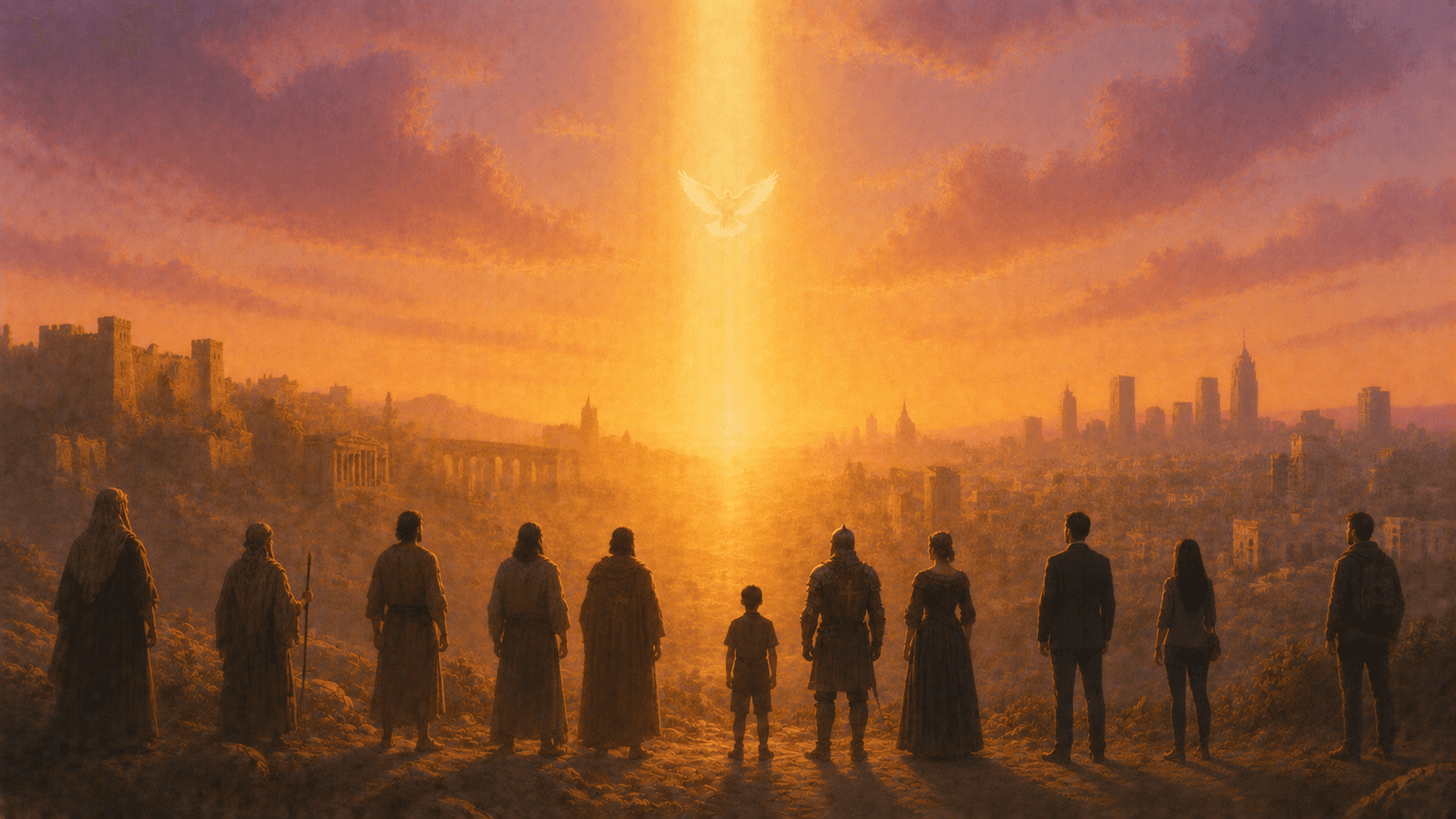
These cases span 2,000 years, five continents, and radically different cultural contexts. Yet the patterns are unmistakable.
Every one of these healers refused personal credit and pointed to the same source — a Power beyond themselves, which they variously called God, the Father, the healing stream. None described what they were offering as a method or technique. They described it as an opening — something that becomes possible when the person genuinely surrenders the grip of their fears, resentments, and ego-driven patterns.
The obstacle identified was also consistent: not the disease itself, but the inner state that created the conditions for it. Fear. Bitterness. Unforgiveness. Self-rejection. Worry. These, Wright and Carmichael documented, have measurable biological consequences. Gröning called them blockages in the healing stream. Jesus called it the absence of faith — not intellectual belief, but genuine inner openness.
And the results, in the documented cases, defied the limits of biology. Bone destroyed by cancer regrew. Spines frozen for decades moved freely. Eyes blind for years saw. Not through positive thinking or suggestion, but through something that appeared to shift at a level below the biological — and that the biology then followed.
What This Points Toward
There is a thread running through all of humanity's wisdom traditions — described in different language, but pointing to the same recognition: we are not only bodies. At the deepest level of the human being, there is something that is not bound by time or space, that knows right from wrong before thought can form, that is aligned — when it is heard — with what every tradition has called Love, or Truth, or God's Will.
This is what the healers in this article, across their different traditions and centuries, were helping people reconnect with. The spirit — the inner conscience, the deeper voice — is the part of us that can connect to the Power that heals. The problem is that most people can no longer hear it. The noise of our thoughts, our fears, our emotions, and our personality patterns has become so constant that the quieter, deeper voice has been drowned out.
We make our decisions from the level of our worries and our limited, earthly perspective. We drown in our emotions. We believe and listen to our thoughts. Flailing and overwhelmed, we lack a stable anchor and lighthouse to lead us the right way. And the body — cut off from access to what ultimately sustains it — does what it does in the absence of that connection.
The obstacle to healing is consistently found not in the body, but in the disconnection from the layer that animates it.
This is not a religious argument. It is what the evidence, accumulated over centuries and subjected to serious medical scrutiny, consistently points toward.
A Different Kind of Care
At The Healing Dawn, we take this evidence seriously — not as a replacement for medicine, but as the missing dimension that medicine alone cannot provide.
The body, as the vessel of the spirit, needs precise, evidence-based physical care — nutrition, movement, rest, naturopathic principles that recognize the laws governing health extend far beyond what any drug can provide. But beneath all of that is a deeper layer: the understanding of who we truly are, and why we are here — and the recognition that our submission to our toxic thoughts and limiting emotions, instead of our connection to and strengthening of our spirit, is where so much suffering begins.
True healing is multi-dimensional. And its deepest level — the restoration of access to the Power that animates us — is what every healer in this article, across their very different traditions, was ultimately pointing toward.
The body knows how to heal. The question is whether it has access to what it needs or it is blocked from it. That access runs through the spirit. And the spirit, when it is heard, always points in the same direction.
Toward Love. Toward alignment. Toward Divine healing that is real.
— The Healing Dawn